Edge AI: What It Is and How It Facilitates Smart Logistics

- Edge AI processes data where it is generated, not in distant servers. Decisions that once took hours can now happen in seconds, helping improve delivery speed and operational efficiency.
- Data stays on local devices instead of being uploaded to the cloud. This enhances privacy, reduces security risks and makes compliance easier.
- Edge devices can continue operating even when internet connectivity is disrupted, ensuring business operations keep running.
- Edge AI and cloud AI work best together. Edge AI handles real-time decisions locally, while cloud AI manages large-scale processing and analysis, creating a faster and more intelligent logistics ecosystem.
- Implementation does not have to happen all at once. Start with a single use case, such as vehicle tracking, measure the results and expand gradually.
- What Is Edge AI?
- What Are the Basic Features of Edge AI?
- What Are the Benefits of Using Edge AI in Smart Logistics?
- Which Industries Can Use Edge AI?
- What Is the Difference Between Edge AI and Cloud AI?
- What Are Some Challenges Associated with Using Edge AI?
- Avail Smart AI-Powered Courier Allocation with Shiprocket Cargo
When you’re running a growing online business, logistics can make or break the customer experience. A delayed shipment, a damaged package discovered too late or a delivery vehicle stuck in traffic can quickly lead to complaints, returns and lost sales. When every order matters, these disruptions can have a real impact on your business.
Many of these issues stem from delayed information. A damaged shipment may be detected hours later. A congested route may only be identified after customers complain. Equipment failures can disrupt operations before anyone notices. As data travels from warehouses and vehicles to distant servers for processing, valuable time is lost and those delays can add up across hundreds or thousands of shipments.
But what if decisions could happen instantly, right where they matter? Edge AI is making that possible. Let’s explore how it can transform logistics operations.
What Is Edge AI?
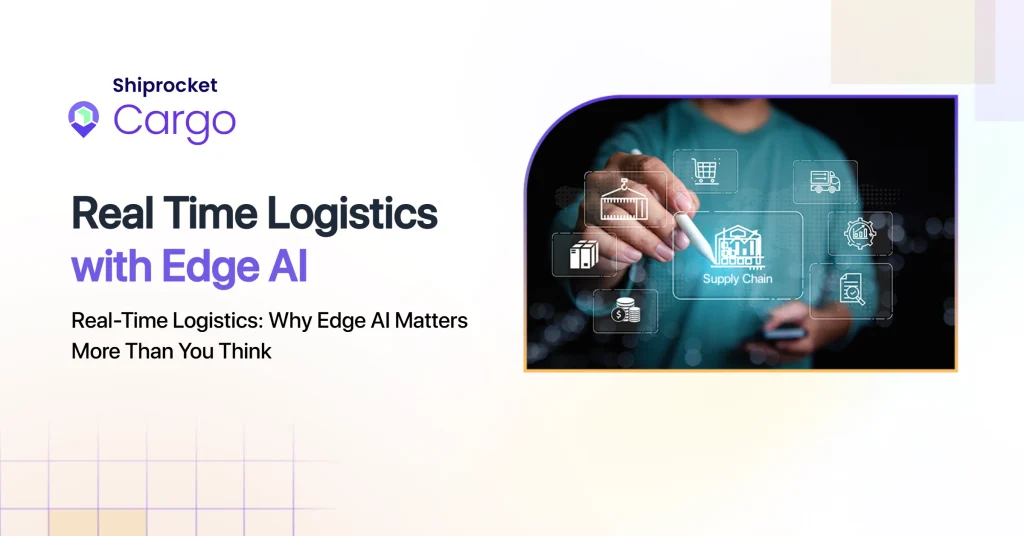
Edge AI is artificial intelligence that processes data on the device where it is generated, instead of sending it to a remote cloud server. The device collects data, analyses it and responds in real time.
Unlike traditional systems that rely on cloud processing, Edge AI works locally, reducing delays.
For example, a smartphone can recognise your face, a security camera can detect unusual activity and a factory machine can identify faults without sending data elsewhere.
What Are the Basic Features of Edge AI?
Before deciding whether to use Edge AI in your supply chain, it helps to understand its key features:
- Real-Time Processing: Edge AI processes data locally, allowing devices to analyse information and act immediately without relying on distant servers. This is critical for applications that require instant decisions.
- Functions Without Internet: Because processing happens on the device itself, Edge AI can continue operating even when internet connectivity is unavailable or unreliable.
- Data Remains on the Device: Data is processed and stored locally whenever possible, reducing the need to transmit sensitive information across networks and supporting better privacy and security.
- Reduces Bandwidth Consumption: Only important insights or alerts are transmitted, rather than raw data streams. This reduces network usage and lowers operational costs.
- Improves Through Real-World Experience: Devices can send new data to the cloud for model updates and retraining. The improved models are then deployed back to edge devices, helping the system become more accurate over time.
- Requires Edge Hardware: Edge AI relies on hardware such as sensors, cameras, processors and connectivity devices to collect, process and transmit data when needed.
- Responds Instantly: Machine learning models run on your device. Decisions happen immediately based on what’s happening right now. No transmission delays. No waiting.
What Are the Benefits of Using Edge AI in Smart Logistics?
Edge AI helps logistics businesses respond faster, reduce disruptions and improve operational efficiency. Here are some of its key benefits:
- Faster Deliveries
Routes can adapt to changing conditions in real time. Traffic issues and bottlenecks are identified early, helping shipments reach customers more quickly.
- Fewer Shipment Losses and Damages
Problems can be detected during warehousing and transit before they escalate. Damaged goods are flagged immediately, reducing losses and improving customer satisfaction.
- More Reliable Equipment
Potential issues can be identified before equipment fails. This enables timely maintenance, reduces downtime and helps keep operations running smoothly.
- Improved Workforce Productivity
Routine monitoring and alerts are handled automatically, allowing employees to focus on resolving issues and managing higher-value tasks.
- Stronger Customer Experience
Faster, more reliable deliveries improve service quality and customer trust, helping businesses retain customers and stand out in a competitive market.
- Lower Operational Costs
Reduced equipment failures, fewer shipment losses and lower bandwidth usage help control costs and make logistics operations more efficient.
Which Industries Can Use Edge AI?
Edge AI is used across industries where speed, local processing and instant decision-making matter. Here are some of the sectors benefiting from this technology:
- Manufacturing: Edge AI detects production defects in real time and monitors equipment performance. This helps reduce waste, improve quality control and identify maintenance needs before machines fail.
- Healthcare: Edge AI enables real-time monitoring of patients and faster analysis of medical images. It also helps keep sensitive health data on local devices, supporting privacy and security.
- Automotive: Edge AI allows vehicles to process data and react to road conditions instantly. It is widely used in autonomous driving systems, driver assistance features and drones.
- Retail: Edge AI helps retailers monitor inventory, track shelf stock and analyse in-store activity in real time. It can also support local checkout operations during network disruptions.
- Smart Cities: Edge AI powers real-time traffic management, smart parking systems and adaptive street lighting by processing data locally and responding to changing conditions instantly.
- Agriculture: Edge AI enables drones and sensors to detect crop issues, monitor soil conditions and optimise irrigation in real time, helping improve productivity and resource use.
- Financial Services: Edge AI helps detect fraudulent transactions as they occur, allowing financial institutions to verify activity and respond to threats more quickly.
- Restaurants: Edge AI supports point-of-sale systems, inventory monitoring and operational continuity by enabling local processing even when internet connectivity is unavailable.
What Is the Difference Between Edge AI and Cloud AI?
Both edge and cloud AI help in different situations. Understanding how they differ makes the choice much easier when you know what you want to achieve:
| Key differences | Edge AI | Cloud AI |
| Processing Location | On-device hardware | Remote servers |
| Speed | Instant | Network-dependent delay |
| Internet Requirement | Not required | Required |
| Data Privacy | Data stays local | Data travels across networks |
| Computing Capacity | Device-limited | Virtually unlimited |
| When to Use | Immediate response needed (autonomous vehicles, safety systems), unreliable connectivity, sensitive data (medical, financial) | Heavy computation (model training), large user scale, lightweight devices accessing advanced capabilities |
| Use Cases | Self-driving car obstacle detection, remote area drones, wearable health monitoring and on-site video analysis | Model training on large datasets, recommendation systems at scale, API-based AI services |
Most systems use both. Edge AI handles what needs to happen immediately, while cloud AI handles the heavy processing. Your choice should depend on business needs, such as performance, security, internet connectivity or computing resources.
What Are Some Challenges Associated with Using Edge AI?
While Edge AI offers significant benefits, it also comes with certain challenges:
- Hardware Capacity
Edge devices such as smartphones, cameras, sensors and drones have limited processing power compared to cloud servers. To run AI models on these devices, models often need to be compressed or simplified, which can reduce accuracy and performance.
- Power and Heat Constraints
Many edge devices rely on batteries. Running AI models consumes power and generates heat, which can reduce battery life and affect device performance. Developers often need to optimise models to balance efficiency and functionality.
- Updating Distributed Devices
Unlike cloud systems that can be updated centrally, edge devices are spread across different locations and networks. Deploying updates, fixing bugs and maintaining version consistency across devices can be challenging.
- Environmental Variation
AI models are often trained under specific conditions, but real-world environments vary. Changes in lighting, weather, location or operating conditions can affect model performance and accuracy.
- Physical Security Risks
Edge devices operate in the field and can be physically accessed, tampered with or stolen. Protecting these devices requires additional security measures, which can consume limited device resources.
- Accuracy vs Efficiency
Edge devices have limited memory, storage and computing power. As a result, businesses often need to balance model accuracy with resource efficiency, as more advanced models may be too demanding for edge hardware.
Avail Smart AI-Powered Courier Allocation with Shiprocket Cargo
As your business grows, managing bulk shipments can become increasingly complex. You’re coordinating with multiple freight partners, comparing rates, tracking shipments across different platforms and trying to ensure deliveries arrive on time. What you need is a single solution that simplifies bulk shipping, tracking, cost management and delivery operations.
Shiprocket Cargo brings 14+ freight partners onto one platform, making bulk logistics easier to manage. Instead of negotiating with multiple vendors, you can compare options and choose the service that best fits your requirements.
With rates starting at INR 6/kg and coverage across 19,000+ PIN codes, businesses can ship efficiently across India. You also get live shipment tracking, scheduled delivery slots and dedicated support to help keep your operations running smoothly.
Conclusion
The biggest advantage of Edge AI is not the technology itself. It’s the ability to act on information the moment it becomes available. In logistics, even small delays can lead to missed deliveries, damaged shipments, higher costs and dissatisfied customers. Edge AI helps reduce those delays by bringing intelligence closer to where operations happen.
For businesses looking to improve logistics performance, the goal doesn’t have to be a complete transformation overnight. Start with one area where delays create the most impact, such as vehicle tracking, warehouse monitoring or equipment maintenance. As results become visible, you can expand gradually.
Yes. One of the main advantages of Edge AI is that it can process data locally without relying on a constant internet connection. This makes it useful for warehouses, vehicles and remote locations where connectivity may be unreliable.
Edge AI can improve data security because information is processed on local devices instead of being continuously transmitted to external servers. However, businesses still need proper device security, encryption and access controls to protect data.
Edge AI processes data on local devices for faster decision-making, while cloud AI performs large-scale data storage and complex analysis on remote servers. Many businesses use both together, with each handling tasks it is best suited for.
Edge AI is particularly useful for real-time applications such as vehicle tracking, route optimisation, warehouse monitoring, inventory management, predictive maintenance and shipment condition monitoring.
Before adopting Edge AI, businesses should identify the processes that require real-time decisions, evaluate their existing hardware and connectivity infrastructure and assess whether the expected operational benefits justify the investment.