How Robotics and Automation Are Changing Supply Chains
- Robots in logistics are automated systems designed to perform specific tasks within a supply chain.
- Moving goods, sorting parcels, and picking orders are tasks that manual processes cannot sustain at volume without errors building up.
- Businesses are adopting automation to reduce costs, minimise order errors, and keep operations running, even as finding reliable warehouse staff is becoming harder.
- High setup costs, warehouses not built for automation and limited trained staff outside large cities are the main barriers to adoption.
- For sellers, the starting point is fixing order processing, cleaning up product and inventory data, and choosing tools that connect to existing systems.
- What Are Logistics Robots?
- Why Are Businesses Adopting Robotics and Automation in Logistics?
- Types of Logistic Robots and Their Applications
- Challenges Businesses Face When Implementing Logistics Automation
- How Robotics Supports Better Cargo and Supply Chain Operations
- How Sellers Can Start Adopting Logistics Automation
- Scale Logistics Operations Efficiently With Shiprocket Cargo
- Conclusion
As your business grows, so do operational challenges. More orders can lead to packing mistakes, inventory mismatches, delayed shipments and an increased reliance on manual processes that become difficult to manage at scale.
This is where logistics automation is becoming important. Getting an order from a warehouse shelf to a customer’s doorstep involves multiple steps, many of which have traditionally relied on manual work. The global warehouse automation market is projected to reach USD 59.52 billion by 2030, up from USD 29.98 billion in 2026, while 40% of warehouses in India are expected to be fully automated by 2030.
For sellers, this shift will increasingly influence speed, efficiency and the ability to scale operations smoothly.
What Are Logistics Robots?
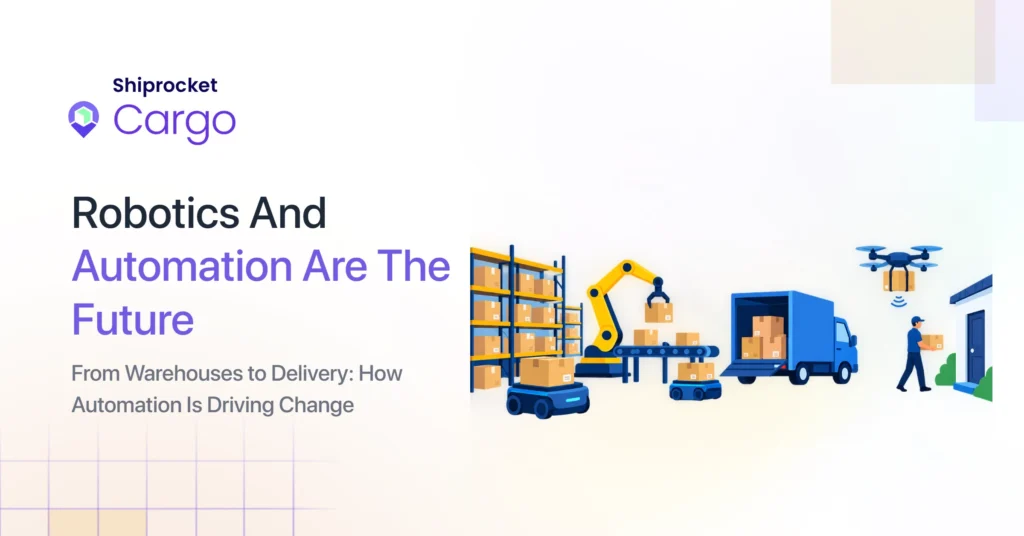
Robots in logistics are automated systems designed to handle, move, sort and process goods within a supply chain. These include robotic arms, autonomous mobile robots, automated guided vehicles, smart conveyors and drones, each built for a specific task.
Unlike basic machinery, logistics robots can read order data, make routing decisions and adapt to changing warehouse conditions with limited human intervention.
In India, Automated Guided Vehicles are currently the most widely used because they work well with existing warehouse setups, while drone deliveries are still under regulatory development and remain some years away from large-scale eCommerce use.
Why Are Businesses Adopting Robotics and Automation in Logistics?
Businesses are adopting logistics automation primarily to reduce costs, improve accuracy and scale. Automation can reduce operational costs by up to 40%, while falling robot prices have made adoption more accessible.
Businesses also report that error rates have dropped by up to 50%, reducing returns and customer dissatisfaction. Additionally, with 52% of warehouses struggling to find and retain reliable staff, automation helps handle repetitive, labour-intensive tasks without relying entirely on workforce expansion.
Types of Logistic Robots and Their Applications
Here are some of the most widely used robots in logistics and where they make the most difference:
- Automated Guided Vehicles (AGVs)
AGVs transport goods along fixed paths using magnetic strips, lasers or QR codes. They are widely used because they are reliable, low maintenance and require minimal supervision. Their main limitation is flexibility, as layout changes often require reprogramming routes.
- Autonomous Mobile Robots (AMRs)
AMRs use sensors to navigate and adjust to changing environments. Unlike AGVs, they can avoid obstacles and adapt to new layouts without fixed routes. Companies using AMRs report picking speeds increasing by up to 50%. Their adoption is also accelerating, with the AMR market expected to grow from USD 7.07 billion in 2026 to USD 7.07 billion by 2032.
- Robotic Arms
Robotic arms handle repetitive tasks such as picking, packing, palletising and assembly. They are useful where consistency and accuracy are important, especially in high-volume operations.
- Cube Storage Robots
Cube storage robots retrieve items from dense storage grids and bring them directly to workers. They help reduce walking time and improve efficiency where storage space is limited.
- Sortation Robots
Sortation robots scan labels and automatically route packages to their destinations. They are particularly useful during peak demand periods when manual sorting becomes difficult.
- Collaborative Robots (Cobots)
Cobots work alongside employees by handling repetitive or physically demanding tasks such as lifting, scanning and moving inventory, allowing staff to focus on higher-value work.
- Automated Storage and Retrieval Systems (AS/RS)
AS/RS uses automated cranes and platforms to locate and retrieve inventory. They reduce retrieval time, improve storage efficiency and minimise manual errors.
- Swarm Robots
Swarm robots are groups of small robots that communicate and work together to complete tasks without constant human supervision. They are designed for large-scale sorting, fulfilment and movement tasks where speed and flexibility are important. Their adoption is increasing, with companies such as Geek+ and Locus Robotics deploying over 30,000 swarm robots worldwide.
- Drones
Drones are primarily used for inventory checks and warehouse monitoring, especially for scanning high shelves. While delivery use cases exist, large-scale eCommerce deliveries remain under development.
Challenges Businesses Face When Implementing Logistics Automation
Automation is a good idea to make your logistics more efficient. But there are many challenges that you are likely to face:
- High Upfront Costs: The cost of robotic systems, software and setup is significant before any returns are realised. For businesses with limited budgets, the gap between investment and payback can delay adoption.
- Warehouse Infrastructure Gaps: Most warehouses are not designed for automation. Existing layouts and storage systems often require modification before automation can be implemented, adding extra upfront cost and effort.
- Shortage of Trained Staff: Operating and maintaining automated systems requires technical expertise. Outside major urban centers, such talent is limited and training existing teams takes time.
- Integration with Existing Software: Businesses already rely on order, inventory and billing systems. Integrating automation with these systems often requires custom development to ensure smooth, uninterrupted operations.
- Limitations of Automation and Robots: Automation is most effective for repetitive, high-volume tasks. For exceptions such as irregular package sizes or sudden process changes, manual intervention is still required.
How Robotics Supports Better Cargo and Supply Chain Operations
Robotics has changed how goods move, how stock is tracked and how errors are caught before they become costly. Here is how they impact supply chain and logistics:
- Faster Movement of Goods: AMRs and AGVs move pallets and goods across facilities without manual involvement, ensuring consistent operations across long shifts without slowdowns caused by fatigue or human error.
- Fewer Order Errors: Robotic picking systems use sensors and AI to sort, pick and pack orders more accurately than manual processes, reducing wrong shipments, returns and refunds.
- Efficient Packaging and Palletising: Automated systems manage loading, unloading and packaging mixed consignments at scale, improving consistency and reducing product damage during handling.
- Real-time Stock Visibility: Drones and AS/RS systems scan storage areas to provide accurate inventory data at any time, reducing reliance on manual checks that are slower and more error-prone.
- Safer Working Conditions: Robots handle heavy lifting and repetitive physical tasks that often lead to workplace injuries, allowing employees to focus on tasks that require human judgment.
How Sellers Can Start Adopting Logistics Automation
Automation does not begin with buying robots. For most sellers like you, it starts with fixing what is already broken in your current process.
- Identify where your process breaks down: examine where errors occur most often. Manual order entry, labelling and customer follow-ups are areas where automation delivers the fastest impact.
- Sort your data before anything else: Automated systems depend on accurate data. If stock levels are outdated, product dimensions are missing or orders are recorded differently across platforms, the output will be incorrect regardless of the technology used.
- Start with one area, not everything: Begin with order processing. Syncing sales channels, generating shipping labels and sending automated tracking updates are where most sellers see immediate improvements.
- Choose tools that work with what you already have: A tool that does not connect to your inventory or order system often creates more work. Integration with existing setups is key.
- Prepare your team for the change: Your team shifts from manual execution to system management and exception handling. Time is needed to understand and adapt to the new workflow.
- Track performance: Once automation is live, monitor outcomes. Faster order flow, fewer errors and reduced manual workload indicate whether you are ready to scale further.
Scale Logistics Operations Efficiently With Shiprocket Cargo
As shipment volumes grow, managing freight across multiple partners becomes complex. Shiprocket Cargo simplifies this by bringing operations onto one platform, with coverage across 19,000+ pincodes, rates starting at ₹6/kg and access to 14+ freight partners.
You can ship via road using LTL, PTL or FTL, or choose air cargo when speed is important. The platform suggests the right courier based on weight, destination and timeline, reducing manual decision-making. Real-time tracking provides visibility throughout transit, appointment-based deliveries help reduce failed attempts and Early COD enables faster payment cycles.
Conclusion
Robotics and automation are reshaping supply chains, directly influencing how quickly and accurately orders reach customers. From warehouse picking to last-mile delivery, the shift is already underway and customer expectations are rising alongside it.
What matters most is not whether every seller fully automates operations, but how effectively logistics processes are improved step by step. Even small upgrades in order processing, data accuracy and partner selection can meaningfully improve delivery speed, reduce costs and enhance customer experience.
Staying competitive is less about owning infrastructure and more about making better operational decisions today that can scale with your business as it grows.
Yes. Through Robotics-as-a-Service (RaaS), businesses can access automation on a subscription or usage-based model instead of investing in full ownership. Companies like Addverb and GreyOrange already offer such models in India.
Payback periods vary depending on scale and implementation, but many businesses see returns within 18 to 24 months, especially when automation is applied to high-volume or repetitive processes.
Productivity gains typically range from 25% to 70%, depending on the level of automation, order complexity and warehouse size.
Yes. Companies such as Addverb, Unbox Robotics and GreyOrange are developing systems tailored to local warehouse conditions and operational constraints.
The biggest barriers are infrastructure readiness, integration with existing software systems and the need for skilled personnel to manage and maintain automated workflows.