

Retail Supply Chain Management: Guide & Strategies

- What Is Retail Supply Chain Management?
- How Does Retail Supply Chain Management Work?
- What Are the Key Components of Retail Supply Chain Management?
- Why Is Retail Supply Chain Management Important?
- What Are the Challenges in Retail Supply Chain Management?
- What Are the Best Strategies for Effective Retail Supply Chain Management?
- 1. Use Data for Demand Forecasting
- 2. Maintain Accurate Inventory Records
- 3. Improve Supplier Collaboration
- 4. Optimise Warehouse Operations
- 5. Choose Suitable Transportation Options
- 6. Improve Shipment Visibility
- 7. Plan Replenishment Proactively
- 8. Review Logistics Partner Performance
- 9. Build Contingency Plans
- How Does Technology Improve Retail Supply Chain Management?
- What Is the Difference Between Retail Supply Chain Management and Retail Logistics?
- What Is the Difference Between Retail Supply Chain Management and Inventory Management?
- How Does Retail Supply Chain Management Work for B2B Businesses?
- How Can Shiprocket Cargo Support Retail Supply Chain Management?
- Which KPIs Should Retailers Track for Supply Chain Management?
- What Are the Emerging Trends in Retail Supply Chain Management?
- Related Shiprocket Cargo Resources
- Conclusion
What Is Retail Supply Chain Management?
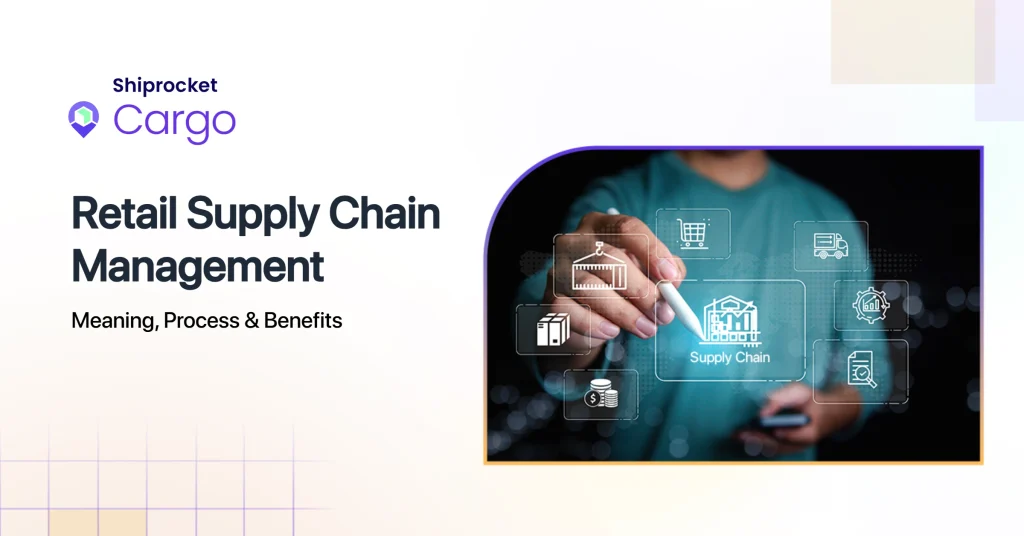
Retail supply chain management (RSCM) is the process of planning, coordinating, and managing the movement of products from suppliers and manufacturers to retail businesses and their customers.
It covers the activities involved in sourcing products, managing inventory, storing goods, transporting shipments, fulfilling orders, and handling returns.
The primary objective of retail supply chain management is to ensure that the right products reach the right locations, in the required quantities, at the right time, and at an appropriate cost.
For example, a clothing retailer needs to source garments from manufacturers, transport them to warehouses, distribute inventory across stores, and replenish stock based on customer demand.
If one stage experiences a delay, the retailer may face stock shortages, missed sales, or higher operating costs.
An effective retail supply chain connects these activities so that businesses can manage inventory, transportation, and customer demand more efficiently.
How Does Retail Supply Chain Management Work?
Retail supply chain management follows a series of connected activities that move products from their source to the end customer.
The exact process varies by business model, product category, and sales channel. However, a typical retail supply chain follows these stages.
1. Sourcing and Procurement
The process begins with identifying suppliers and purchasing the products or materials required by the business.
Retailers evaluate suppliers based on product quality, pricing, availability, production capacity, and delivery timelines.
Effective procurement helps retailers maintain a steady supply of products while managing purchasing costs.
2. Manufacturing and Production
For retailers selling manufactured products, this stage involves producing goods according to demand, specifications, and quality requirements.
Retailers that source finished products may work directly with manufacturers rather than managing production themselves.
Production planning needs to align with expected demand to avoid shortages or excess inventory.
3. Warehousing and Storage
After production or procurement, goods are stored at warehouses, distribution centres, or fulfilment facilities.
Warehousing helps retailers maintain inventory before distributing products to stores, distributors, or customers.
Efficient warehouse operations include receiving, checking, storing, picking, packing, and preparing products for dispatch.
4. Inventory Management
Inventory management involves monitoring stock levels across warehouses, retail stores, and online sales channels.
Retailers need to balance inventory availability with storage costs and the risk of unsold stock.
Accurate inventory records help businesses understand which products need replenishment and where stock is available.
5. Transportation and Distribution
Transportation moves products between suppliers, warehouses, distribution centres, retail stores, and customers.
Retailers may use road freight, rail, air, or multimodal transportation depending on shipment requirements.
For B2B distribution, transportation also involves coordinating bulk shipments, delivery schedules, and receiving locations.
6. Order Fulfilment and Delivery
Once a customer places an order, the retailer processes it and prepares the product for delivery or collection.
Depending on the business model, fulfilment may involve:
- Shipping from a central warehouse
- Shipping directly from a retail store
- Delivering products to another business
- Enabling in-store pickup
- Using a third-party fulfilment provider
The goal is to fulfil orders accurately and meet the promised delivery timeframe.
7. Returns and Reverse Logistics
Retail supply chains also manage products that customers return.
Returned products may need inspection, repackaging, restocking, repair, or disposal, depending on their condition and the retailer’s policies.
An organised returns process helps retailers manage inventory accurately and reduce avoidable losses.
What Are the Key Components of Retail Supply Chain Management?
Retail supply chain management brings several business functions together. Each component affects product availability, operational efficiency, and delivery performance.
1. Demand Forecasting
Demand forecasting helps retailers estimate how much customers are likely to purchase during a specific period.
Businesses can use historical sales, seasonal patterns, promotions, and current market trends to plan inventory and procurement.
For example, a retailer selling festive decorations may need to increase stock before Diwali and reduce replenishment after the peak season.
2. Supplier Management
Supplier management involves selecting suppliers, coordinating orders, monitoring performance, and maintaining reliable business relationships.
Retailers need to align purchase quantities and delivery schedules with supplier capacity and customer demand.
Strong supplier coordination can help reduce procurement delays and improve product availability.
3. Inventory Management
Inventory management ensures that the right quantity of products is available at the right location.
Retailers need to avoid two common problems:
- Overstocking: Excess inventory increases storage costs and the risk of unsold or obsolete products.
- Stockouts: Insufficient inventory can lead to missed sales, delayed fulfilment, and customer dissatisfaction.
Accurate stock records and timely replenishment help businesses maintain a better balance.
4. Warehouse Management
Warehouse management covers the receiving, storage, picking, packing, and dispatch of products.
Efficient warehouse processes can improve order accuracy and reduce the time required to prepare shipments.
Retailers managing multiple warehouses also need visibility into where inventory is located and which facility should fulfil an order.
5. Transportation and Logistics
Transportation connects suppliers, warehouses, stores, and customers.
Retailers must choose suitable transportation options based on shipment weight, volume, distance, urgency, and cost.
For larger business shipments, LTL transportation may be appropriate when the cargo does not require an entire truck.
6. Order Management
Order management coordinates the processing and fulfilment of orders across sales channels.
For omnichannel retailers, this may include orders placed through websites, marketplaces, mobile applications, and physical stores.
Connected order and inventory systems help businesses identify available stock and select an appropriate fulfilment location.
7. Shipment Visibility
Shipment visibility allows businesses to monitor the movement of goods and identify delays or delivery exceptions.
Tracking information helps retailers coordinate with suppliers, logistics partners, warehouse teams, and receiving locations.
8. Returns Management
Returns management covers the movement and processing of products sent back by customers or business buyers.
A clear returns process helps businesses determine whether products can be resold, repaired, restocked, or need further handling.
Why Is Retail Supply Chain Management Important?
Retail supply chain management affects how efficiently businesses source, store, distribute, and deliver products.
Here are some of its key benefits.
1. Improves Product Availability
Effective supply chain planning helps retailers maintain sufficient stock across stores, warehouses, and online channels.
Better availability reduces the risk of losing sales because products are unavailable when customers want them.
2. Helps Control Operating Costs
Retailers incur costs throughout the supply chain, including procurement, warehousing, transportation, inventory holding, and returns.
Coordinating these activities can help businesses identify unnecessary expenses and improve resource utilisation.
3. Supports Better Customer Experiences
Customers expect products to be available and delivered within the promised timeframe.
A well-managed supply chain helps retailers provide more consistent fulfilment and delivery experiences.
4. Reduces Inventory Imbalances
Retailers often manage products across multiple locations.
Supply chain visibility helps businesses identify excess inventory in one location and shortages in another, supporting more informed replenishment decisions.
5. Supports Business Expansion
As retailers expand into new cities, stores, marketplaces, or sales channels, their logistics requirements become more complex.
A scalable supply chain helps businesses coordinate inventory and distribution across a wider network.
6. Improves Business Decision-Making
Supply chain data helps retailers understand demand patterns, stock movement, supplier performance, transportation costs, and fulfilment issues.
These insights can support more informed purchasing and distribution decisions.
What Are the Challenges in Retail Supply Chain Management?
Retailers face several challenges as they manage changing demand, multiple suppliers, inventory locations, and delivery requirements.
1. Demand Fluctuations
Customer demand can change due to seasonal events, promotions, changing preferences, and market conditions.
If retailers underestimate demand, they may experience stockouts. If they overestimate it, they may hold excess inventory.
2. Inventory Inaccuracy
Incorrect stock records can create problems across retail supply chains.
A product may appear available in the system even when it is out of stock or located at a facility that cannot fulfil the order efficiently.
3. Supplier Delays
Production issues, raw material shortages, capacity constraints, or transportation disruptions can delay supplier deliveries.
These delays can affect procurement schedules, inventory availability, and store replenishment.
4. Rising Transportation Costs
Fuel expenses, route inefficiencies, shipment size, handling requirements, and delivery distance can affect logistics costs.
Retailers managing frequent or multi-location shipments need to evaluate transportation options carefully.
5. Limited Supply Chain Visibility
When inventory, orders, and shipment information are spread across disconnected systems, retailers may struggle to identify problems quickly.
Limited visibility can delay decisions and make it harder to coordinate suppliers, warehouses, and delivery partners.
6. Omnichannel Complexity
Retailers selling through physical stores, websites, and marketplaces need to coordinate inventory and fulfilment across different channels.
An order placed online may need to be fulfilled from a warehouse or a nearby store, depending on stock availability and delivery requirements.
7. Returns and Reverse Logistics
Returns can create additional transportation, inspection, handling, and inventory management requirements.
Without an organised returns process, products may remain unavailable for resale even when they are physically back with the retailer.
8. Delivery Coordination
B2B retailers and distributors may deliver products to warehouses, distribution centres, and stores with specific receiving requirements.
Missed delivery appointments or incomplete shipments can disrupt receiving operations and replenishment schedules.
What Are the Best Strategies for Effective Retail Supply Chain Management?
Retailers can improve supply chain efficiency by coordinating inventory, procurement, warehouse operations, and transportation.
The following strategies can help businesses build a more organised and responsive supply chain.
1. Use Data for Demand Forecasting
Analyse historical sales, seasonal demand, promotions, and current inventory trends.
Use these insights to estimate future requirements and plan procurement and replenishment.
Forecasts should be reviewed regularly because demand patterns can change.
2. Maintain Accurate Inventory Records
Track inventory across warehouses, stores, and sales channels.
Regular stock reconciliation and timely system updates help retailers make decisions based on actual inventory availability.
3. Improve Supplier Collaboration
Share purchasing plans, delivery schedules, and relevant demand information with suppliers.
Clear communication can help suppliers prepare for changing requirements and reduce avoidable coordination issues.
4. Optimise Warehouse Operations
Review warehouse layouts, receiving processes, storage methods, picking routes, and dispatch procedures.
Standardised workflows and digital inventory systems can help reduce errors and improve order processing.
5. Choose Suitable Transportation Options
Select transportation based on shipment requirements rather than using the same method for every order.
For example:
- Small parcels may use parcel delivery services.
- Larger shipments may require freight transportation.
- Eligible shipments that do not need an entire truck may use LTL.
- Time-sensitive shipments may require express services.
- Deliveries to specific business locations may require appointment coordination.
The appropriate option depends on shipment size, route, delivery timeline, and serviceability.
6. Improve Shipment Visibility
Use shipment tracking and delivery updates to monitor movement across the logistics network.
Identify delays early and coordinate with relevant teams to manage delivery exceptions.
7. Plan Replenishment Proactively
Monitor stock levels and establish replenishment processes based on demand, lead times, and inventory availability.
For retailers supplying multiple stores, distribution planning can help ensure products reach the locations where they are needed.
8. Review Logistics Partner Performance
Evaluate logistics partners using relevant operational measures, such as:
- On-time delivery
- Delivery in full
- Transit time
- Damage rate
- Delivery exceptions
- Shipment visibility
- Cost per shipment
Regular reviews can help businesses identify recurring issues and improve logistics coordination.
9. Build Contingency Plans
Identify alternative suppliers, routes, transportation options, and fulfilment locations where practical.
Contingency planning can help retailers respond to disruptions without relying entirely on a single supply chain route or resource.
How Does Technology Improve Retail Supply Chain Management?
Technology helps retailers coordinate information across procurement, inventory, warehousing, transportation, and order fulfilment.
Different systems support different supply chain functions.
| Technology | Role in Retail Supply Chain |
|---|---|
| Inventory Management System | Tracks stock levels across locations |
| Warehouse Management System (WMS) | Supports receiving, storage, picking, packing, and dispatch |
| Order Management System (OMS) | Coordinates orders and fulfilment across channels |
| Transportation Management System (TMS) | Supports transportation planning and shipment management |
| ERP Software | Connects business processes, including procurement and inventory |
| Analytics and Business Intelligence | Helps identify trends, performance gaps, and operational issues |
| Shipment Tracking Tools | Provide updates on shipment movement and delivery status |
The Role of Data Analytics and AI
Retailers can use data analytics and artificial intelligence to support demand forecasting, inventory planning, and supply chain decision-making.
These technologies can help businesses identify patterns in sales, monitor changing demand, and detect potential operational issues.
However, their usefulness depends on data quality, system integration, and how effectively teams act on the information.
Technology works best when it supports clear processes and coordinated decision-making.
What Is the Difference Between Retail Supply Chain Management and Retail Logistics?
Retail supply chain management and retail logistics are closely connected, but they do not mean exactly the same thing.
| Retail Supply Chain Management | Retail Logistics |
|---|---|
| Manages the broader flow of products and information | Focuses on the movement and handling of goods |
| Includes procurement, supplier coordination, inventory planning, and distribution | Includes transportation, warehousing, handling, and delivery |
| Covers activities from sourcing to customer fulfilment | Supports specific stages of the supply chain |
| Focuses on coordinating the overall supply network | Focuses on moving and storing products efficiently |
In simple terms, retail logistics is an important part of retail supply chain management.
For example, a retailer’s supply chain plan may determine how much inventory to purchase and where to distribute it. Logistics operations then help transport and deliver those products to the required locations.
What Is the Difference Between Retail Supply Chain Management and Inventory Management?
Inventory management is one component of retail supply chain management.
| Retail Supply Chain Management | Inventory Management |
|---|---|
| Coordinates the complete product flow | Focuses on stock levels and availability |
| Includes sourcing, transportation, warehousing, and fulfilment | Includes stock tracking, replenishment, and inventory accuracy |
| Connects suppliers, retailers, logistics providers, and customers | Helps ensure products are available when needed |
For example, inventory management helps a retailer determine how many units of a product are available. Retail supply chain management coordinates how additional units are sourced, transported, stored, and distributed.
How Does Retail Supply Chain Management Work for B2B Businesses?
B2B retail supply chains often involve moving goods between manufacturers, wholesalers, distributors, warehouses, and retail stores.
Unlike individual consumer orders, B2B shipments may involve larger quantities, multiple cartons, pallets, or scheduled deliveries.
A typical B2B retail distribution process looks like this:
Manufacturer → Distribution Centre → Regional Warehouse → Retail Store → Customer
Depending on the business model, some stages may be combined or bypassed.
Key B2B Supply Chain Requirements
Bulk transportation: Moving larger quantities of goods between business locations.
Inventory replenishment: Maintaining sufficient stock at stores and distribution centres.
Multi-location distribution: Delivering products to multiple stores or warehouses.
Scheduled receiving: Coordinating deliveries with the receiving location’s operating hours and available time slots.
Shipment visibility: Monitoring cargo movement and identifying delays.
Delivery documentation: Maintaining shipment records and proof of delivery.
For businesses managing regular B2B shipments, these requirements need to be considered alongside transportation costs and delivery timelines.
How Can Shiprocket Cargo Support Retail Supply Chain Management?
Retailers, wholesalers, distributors, and manufacturers often need to move bulk shipments between warehouses, distribution centres, and business locations.
As shipment volumes increase, managing transportation, tracking, and delivery coordination manually can become more challenging.
Shiprocket Cargo helps businesses manage B2B and bulk shipping through a technology-enabled logistics platform.
Its relevant capabilities include:
1. B2B and Bulk Shipping
Manage larger business shipments moving between different locations, subject to applicable service requirements.
2. LTL Shipping
For eligible shipments that do not require an entire truck, Less Than Truckload (LTL) shipping provides an option to use shared transportation capacity.
This can be relevant for retailers and distributors shipping smaller freight loads between business locations.
3. Shipment Tracking
Shipment tracking helps businesses monitor cargo movement and stay informed about delivery progress.
This visibility can support coordination between dispatch teams, receiving locations, and business operations.
4. Digital Proof of Delivery
Digital proof of delivery helps businesses maintain delivery records and verify that shipments have reached their destinations.
5. Appointment-Based Delivery
Some retail warehouses, distribution centres, and stores accept shipments only during scheduled receiving windows.
Appointment-based delivery helps coordinate shipments with these requirements and can reduce missed delivery windows.
6. Multi-Location Shipping
Retailers and distributors supplying multiple business locations can use organised shipment management to support their distribution operations.
For businesses looking to streamline B2B and bulk transportation, explore Shiprocket Cargo.
Which KPIs Should Retailers Track for Supply Chain Management?
Retailers should track supply chain performance using metrics that reflect inventory availability, fulfilment accuracy, transportation, and delivery reliability.
| KPI | What It Measures |
|---|---|
| Inventory Turnover | How frequently inventory is sold and replenished |
| Stockout Rate | How often products are unavailable when required |
| Order Accuracy | Whether orders are picked and shipped correctly |
| On-Time Delivery | Whether shipments arrive within the promised timeframe |
| DIFOT | Whether orders are delivered in full and on time |
| Fill Rate | The proportion of demand fulfilled from available inventory |
| Order Cycle Time | Time taken from order placement to fulfilment or delivery, based on the chosen definition |
| Transportation Cost | The cost of moving goods between locations |
| Return Rate | The proportion of orders or products returned |
Businesses should define each KPI consistently and review it alongside relevant operational data.
For example, a low DIFOT rate may require investigation into inventory shortages, warehouse errors, transportation delays, or missed receiving appointments.
Read more about DIFOT meaning, its formula, and how to improve delivery performance.
What Are the Emerging Trends in Retail Supply Chain Management?
Retail supply chains continue to evolve as businesses respond to changing customer expectations, digital commerce, and operational complexity.
Some important areas retailers are focusing on include:
1. Omnichannel Fulfilment
Retailers are coordinating online and offline inventory to support different fulfilment options, such as warehouse shipping, store fulfilment, and in-store pickup.
2. Real-Time Inventory Visibility
Businesses are investing in more connected inventory systems to improve stock accuracy and understand product availability across locations.
3. AI-Assisted Demand Planning
Data analytics and AI tools can support demand forecasting, inventory planning, and identification of potential supply chain issues.
4. More Connected Logistics Operations
Retailers are working to improve coordination between suppliers, warehouses, transportation partners, and receiving locations.
5. Greater Focus on Delivery Performance
Businesses are monitoring delivery reliability, shipment visibility, and fulfilment accuracy alongside transportation speed.
6. Supply Chain Resilience
Retailers are evaluating alternative routes, suppliers, and fulfilment options to prepare for disruptions and changing operating conditions.
The relevance of each trend depends on the retailer’s size, product category, technology infrastructure, and supply chain requirements.
Related Shiprocket Cargo Resources
Explore these related guides to understand transportation, distribution, and delivery performance for retail and B2B businesses:
- Top 10 Transport Companies in India
- DIFOT: Meaning, Formula, and How to Improve It
- Transloading for Businesses: How It Works
- Pharmaceutical Logistics: How the Supply Chain Works
- LTL Shipping: Meaning and How It Works
- LTL Pricing Guide
- Appointment-Based Delivery: Optimising B2B Shipping
Conclusion
Retail supply chain management is the process of coordinating sourcing, procurement, inventory, warehousing, transportation, fulfilment, and returns to ensure products reach the right locations at the right time.
An effective retail supply chain helps businesses manage inventory, control operating costs, improve product availability, and deliver a consistent customer experience.
However, changing demand, supplier delays, inventory imbalances, transportation costs, and limited shipment visibility can affect supply chain performance.
Retailers can address these challenges through better forecasting, accurate inventory records, supplier collaboration, efficient warehouse operations, shipment tracking, and appropriate transportation planning.
For B2B retailers and distributors, bulk shipping, LTL transportation, multi-location distribution, and appointment-based delivery are also important considerations.
By connecting these activities and regularly reviewing performance, businesses can build a more organised and responsive retail supply chain.
Retail supply chain management is the process of planning and coordinating how products move from suppliers and manufacturers to warehouses, retail stores, and customers. It includes procurement, inventory management, warehousing, transportation, order fulfilment, and returns.
Five major components are procurement, demand forecasting, inventory management, warehousing, and transportation. Order fulfilment, shipment visibility, and returns management are also important parts of the overall process.
It helps retailers maintain product availability, manage inventory, coordinate suppliers, control logistics costs, improve delivery performance, and fulfil customer orders more efficiently.
Common challenges include changing customer demand, inaccurate inventory records, supplier delays, transportation costs, limited shipment visibility, omnichannel complexity, and returns management.
Logistics supports the movement, storage, handling, and delivery of products between suppliers, warehouses, retail stores, and customers. It is an essential part of retail supply chain management.
B2B retail supply chain management involves coordinating the movement of products between businesses, such as manufacturers, wholesalers, distributors, warehouses, and retail stores. It often involves bulk shipments, inventory replenishment, and scheduled deliveries.
Retailers can plan shipment quantities, select suitable freight options, coordinate delivery schedules, monitor shipment movement, and maintain accurate delivery documentation. LTL may be suitable for eligible shipments that do not require an entire truck.
Shiprocket Cargo helps businesses manage B2B and bulk shipments, with capabilities such as LTL shipping, shipment tracking, digital proof of delivery, and appointment-based delivery. These can support shipment visibility and coordination across business locations.